
OUR THINKING
Brand is a way for an organisation to make decisions.
A company builds its brand through what it chooses, repeats and delivers.
Communication makes those choices visible. So do product, pricing, sales, leadership, culture, service and experience. That is why we work with brand as a system connecting strategy, expression and interaction, allowing different people to make decisions from the same direction.
Strategy becomes useful when it helps people decide.
Big decisions set direction. Hundreds of smaller decisions determine whether that direction ever reaches the market.
Which opportunity to pursue. Which campaign to prioritise. How to explain value. Which partnership makes sense. What to protect when pressure for results increases.
A clear enough strategy reduces the need to reinvent these answers every time.
Over time, that continuity makes the organisation easier to recognise and trust.
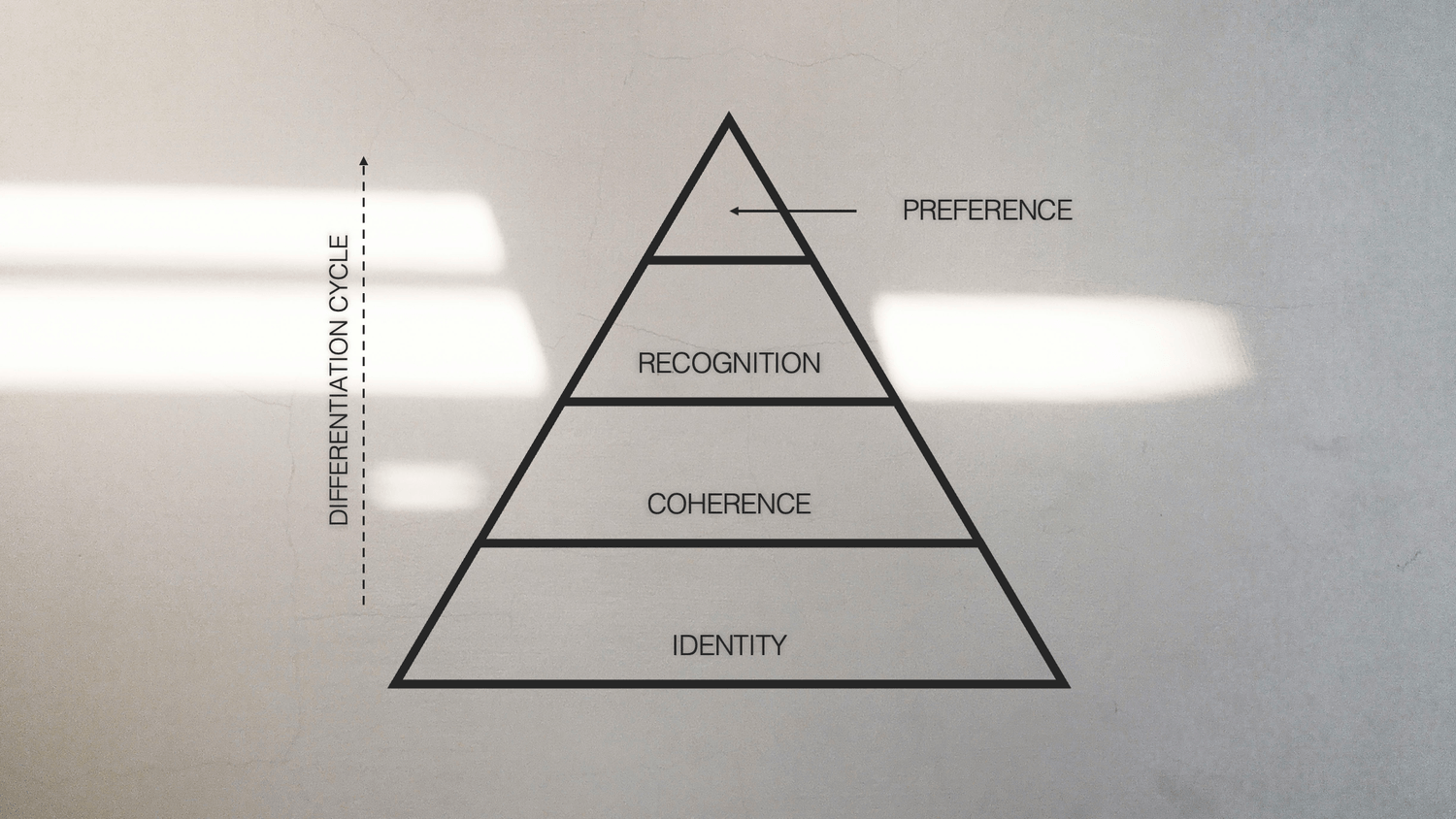
Brand value accumulates through coherence.
Brand equity is not built in a single moment. It accumulates every time an organisation confirms what the market has learned to expect from it.
The greater the coherence between positioning, communication, behaviour and experience, the easier it becomes to recognise value, build trust and create preference.
Coherence does not mean repeating the same thing forever. It means being able to evolve without losing what makes the organisation recognisable.
STRATEGY, EXPRESSION AND INTERACTION
Three dimensions. One brand.
When these three dimensions reinforce one another, each initiative contributes to a shared asset.
Strategy
Clarifies what the organisation is trying to build, where it intends to create value and which choices support that ambition.
Expression
Translates that direction into recognisable positioning, narrative, language, identity and communication.
Interaction
Confirms the promise through sales, service, leadership, culture, behaviour and experience.
THE APB 3 FORCES
What allows an organisation to evolve without losing direction.
Resilience Backbone
A company needs to know what should remain recognisable even when its context changes.
That foundation allows offers, channels, markets and communication to evolve without reopening the identity question from scratch.
Active Meaning
What a brand claims becomes stronger when it is confirmed through experience.
Meaning is built through the relationship between promise, behaviour and delivery, both inside and outside the organisation.
Identity as OS
Identity becomes useful when it stops living only in documents and starts helping people choose.
Priorities, opportunities, communication, behaviour and growth can then begin from the same reference point.
Strategic thinking only creates value when it guides real decisions.
The APB approach structures this transition from intention to practical use through four phases.
F01 Definition
Clarify the identity, ambition and principles that should remain as reference points.
Outcome: less ambiguity around what the organisation is trying to build.
F02 Development
Clarify the identity, ambition and principles that should remain as reference points.
Outcome: less ambiguity around what the organisation is trying to build.
F03 Interaction
Apply the strategy where the brand becomes real: communication, sales, leadership, culture and experience.
Outcome: greater coherence between what the company says and what people actually encounter.
F04 Return
Read results, recognition, learning and deviations.
Outcome: the ability to evolve the strategy without starting again every time the context changes.
The methodology creates enough structure to make better decisions without removing the organisation’s ability to adapt.
Too much happening without enough grounding
Why more activity can create greater dispersion when there is no shared strategic reference.
Brand equity is built by the whole company
How leadership, culture, sales, decisions and experience build, or erode, brand value.
Strategy without structure is just noise
Why strategic intent needs criteria and mechanisms to reach execution.
The myth of visual consistency
Why visual repetition and brand coherence are two different challenges.
Identity as an operating system
How identity can help organisations decide, prioritise and grow.
Where companies create or lose brand equity
The moments where recognition, trust and preference are actually built.
Brand clarity improves the quality of every decision that follows.
APB helps companies and leaders turn identity and strategy into a reference that can be used by the people who decide, communicate and execute.